-01.svg "GGI main logo")


By: Tiago Santana - Founder & CEO, Gray Group International • Serial entrepreneur and growth strategist who has built and scaled multiple companies across technology, media, and consulting. Expert in growth strategist and editorial voice for a global think tank building companies that advance the human experience
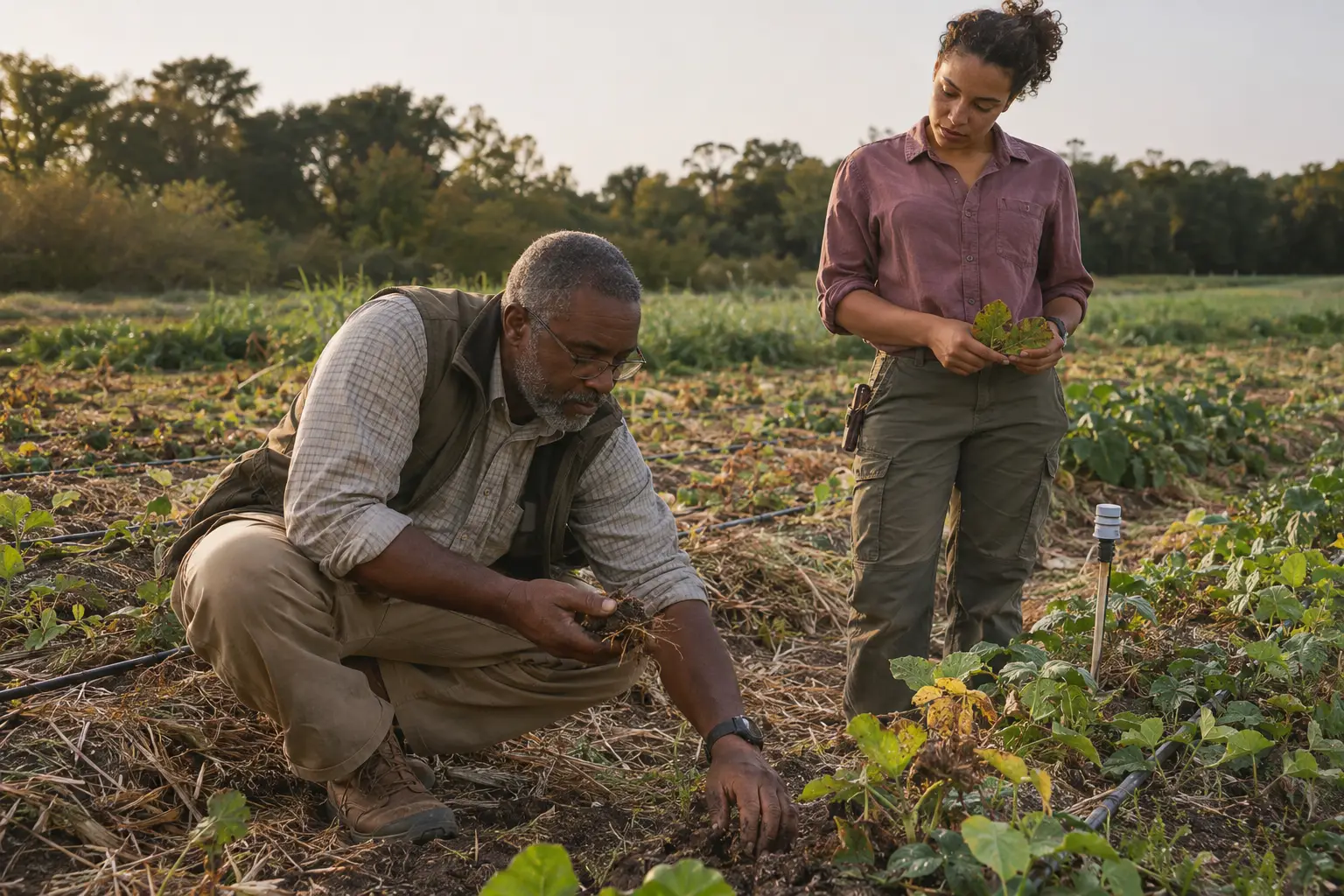
Agricultural sustainability practices are not one fixed method. They are a set of field choices that affect soil, water, nutrients, and shared land use. Some choices improve results in the current season. Others rebuild damaged ground over time. The useful question is not whether a farm uses a label.
It is whether the practice changes day-to-day decisions in a clear way.
A practical view helps separate real management from vague claims. Farmers, buyers, and investors need to know what problem a practice solves, how it is measured, and what tradeoff it creates. That makes sustainability easier to compare across crops, regions, and seasons.
Myth: Sustainable farming labels mean the same thing
They do not. Terms such as climate-smart agriculture, nutrient management, compost use, and soil and water conservation often appear together, but they describe different actions. Confusing them can lead to weak plans, poor spending, and claims that sound useful without changing outcomes.
A better approach is to group practices by function. Some focus on field operations, such as when to apply nutrients or how much seed to use. Others focus on shared systems, such as watershed planning or hillside repair. If those levels are mixed together, a team may fund visible activity while missing the main constraint.
How terms differ in practice and outcomes
Nutrient management is a good example of an operational practice. The U.S. Environmental Protection Agency says it includes soil testing and crop-specific calibration, plus timing fertilizer and manure applications to maximize uptake and reduce runoff (EPA). That is not a slogan. It is a decision process that changes how inputs are used.
Compost sits in a different category. It can support soil health, but it is not always a full fertility plan on its own. The EPA notes that compost does not always contain enough plant-available nutrients to meet the needs of many annual crops (EPA). That detail matters because a soil-building practice can still leave a nutrient gap if it is used alone.
Energy and Sustainability is broader still. In the World Bank's reporting on Ethiopia, it appears as part of sustainable landscape management alongside area closure and soil and water conservation (World Bank). The key point is simple: climate-smart agriculture is best treated as a set of adaptation practices, not as proof that every farm has solved sustainability.
Where sustainability and social impact overlap
Agriculture affects more than yield. It shapes rural income stability, water quality, food security, and whether damaged land can become productive again. That means social impact often depends on careful operations as much as on public promises.
The World Bank's Haiti example shows this clearly. It reports that 2,050 hectares are under sustainable landscape management practices, and 4 sub-watersheds have participatory plans developed (World Bank). The lesson is not just about acreage. It is about how land and water problems often cross property lines and require shared planning.
For founders and executives outside farming, this is the part that is often missed. A procurement rule or climate pledge will not do much if local coordination is weak. Social value usually rises when practical field actions connect with shared governance across a watershed or hillside.
Is it true that agricultural sustainability practices hurt growth?
Not by default. Some practices reduce waste rather than output. Others protect future productivity by keeping soil and water systems in working order. The hard part is designing the transition, not proving that every lower-input change must reduce yield.
Many teams still frame the choice as ethics versus performance. Real farms do not work that way. Input cuts help only when they are paired with careful control over timing, rates, water conditions, and crop needs. Without that control, savings can turn into losses.
When growth strategy aligns with long term yields
One clear example comes from Viet Nam's Mekong Delta. The World Bank reports that efforts there focused on improving water management and reducing seeding rates and agrochemical applications without sacrificing yields (World Bank). That is a useful reminder that more input is not always the same as better output.
The deeper lesson matters for operators and investors alike. Growth becomes more durable when it comes from better decisions rather than heavier input use alone. In most cases, resilience begins with fewer preventable losses, less runoff, less over-application, and less waste in seed or chemical use.
Consider a buyer setting supplier standards across several regions. If that buyer asks only for broad regenerative claims, results will vary. If it asks for soil testing where relevant, crop-based nutrient calibration, and better water management plans, it gets closer to something measurable and reviewable.
How AI and technology sharpen field decisions
Technology helps most when it reduces guesswork. It should make timing clearer, records cleaner, and tradeoffs easier to see. In agriculture, useful digital tools rarely replace agronomic judgment. They support it.
That matters because many sustainability failures are really information failures. Teams apply nutrients by habit instead of crop need. They treat compost as complete nutrition without checking plant-available content. They run pilots on one field while runoff problems continue upstream.
Used well, AI can help sort these choices faster and flag weak assumptions earlier. Gray Group International works at the intersection of growth, technology, and purpose-driven enterprise, so this pattern shows up often across sectors: digital systems create value when they improve decision quality in the real world, not when they add another layer of abstraction.
What actually holds up across regions and seasons
A few principles travel well even when crops and climates differ. Start with measurement before intervention. Match inputs to crop need where possible. Treat water as central rather than secondary. Move beyond plot-level fixes when damage spreads across shared terrain.
Those ideas may sound modest, but that is part of their strength. They hold up better than sweeping claims about one perfect method. In farming, small errors repeated across many fields can matter more than bold statements with no follow-through.
Why soil, water, and biodiversity remain core
Soil health gets attention for good reason. Poor soils lose fertility more easily and often shed water instead of holding it. Water matters just as much because bad timing or poor flow control can erase other gains quickly.
The larger-scale evidence points in the same direction. The World Bank reports that over 2.56 million hectares in Ethiopia have been brought under sustainable landscape management practices, including area closure, climate smart agriculture, and soil and water conservation (World Bank). That suggests a practical truth: long-term productivity often depends on restoring ecological function at scale.
Biodiversity enters the picture through system stability rather than moral language alone. Farms depend on living soils, vegetation cover, pollinators in some systems, and functioning waterways nearby. Once those supports weaken badly enough, production risk usually rises with them.
Take the next step
Gray Group International works with leaders who want to move from reading about this topic to doing something about it. Knowing the right approach is only the start; the harder part is building the team, the process, and the decisions that actually shift results inside your own organization. That second part is where most of the value sits, and it is the part we help with every day.
You Might Also Like
Discover more insights in Sustainability, our full collection of articles on this topic.
Join Disruptors Digest
Insights for a future worth creating. Sustainability, lifestyle, business, and beyond.
Gray Group International is a growth studio helping businesses attract, convert, and retain customers. Our consulting arm, gardenpatch, offers hands-on playbooks and strategy sessions.
