-01.svg "GGI main logo")


By: Tiago Santana - Founder & CEO, Gray Group International • Serial entrepreneur and growth strategist who has built and scaled multiple companies across technology, media, and consulting. Expert in growth strategist and editorial voice for a global think tank building companies that advance the human experience
Consider a distributed team trying to review a physical product, train a new worker. Inspect a site from far away. Video calls may show the meeting, but not the space. That gap matters when the work depends on position, scale, sequence, or shared attention.
A multi-reality approach fits when people need to understand the same thing in space, at the same time. It usually doesn’t fit when the real problem is weak process, poor ownership, or unclear decisions.
Where multi-reality environments outperform standard tools
These systems create value when flat tools strip away context that people need to do good work. Shared space can matter more than richer graphics. If a task depends on where something is, how it moves, or what someone else sees, spatial collaboration can remove guesswork that slides decks and calls often leave behind.
That’s why the category is broader than many leaders expect. A 2021 arXiv survey identified 82 unique systems for remote collaboration, covering more than 100 publications and 25 commercial systems (arXiv, 2021). That range suggests there is no single default model yet. Different jobs need different interaction patterns.
Faster design review across distance
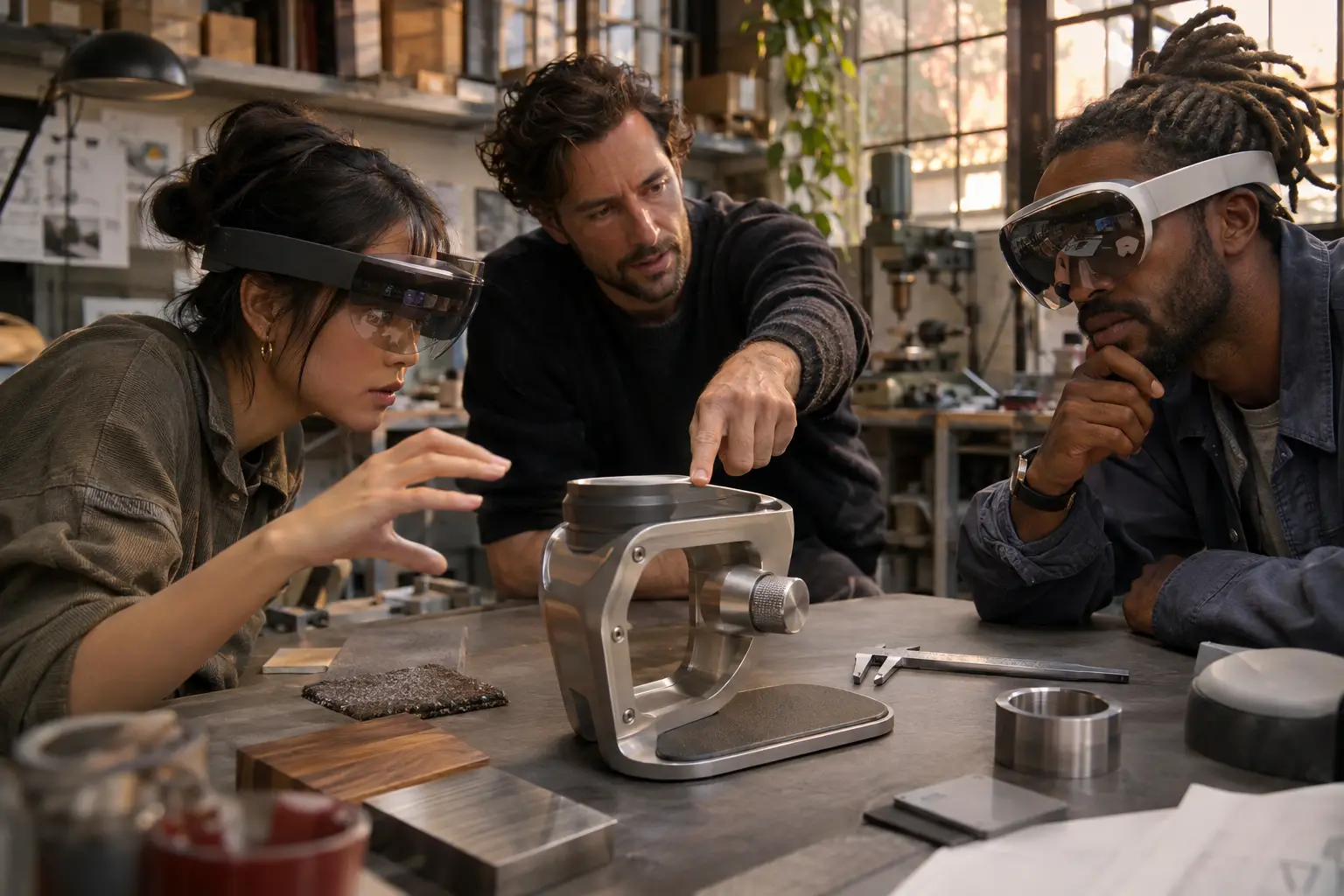
Design review is one of the clearest cases. Teams often struggle when feedback depends on depth, size, angle, or line of sight. A sketch can explain intent. A model on a screen can help. Yet both may fail when several people must inspect the same object and react in real time.
In that setting, shared immersive space can cut ambiguity fast. People can point, annotate, rotate, and compare together. The value isn’t “immersion” by itself. The value is better coordination around a spatial problem. That distinction helps teams avoid buying hardware for work that only needs stronger document habits.
Consider a small manufacturing firm assessing a new layout. If leaders only need approval on cost and timing, ordinary tools may work fine. If they need workers, designers. Operators to spot collisions or safety risks in context, a multi-reality session may surface issues sooner.
Digital transformation with human context
Many digital projects fail because they remove friction in one place while adding confusion somewhere else. Multi-reality systems are no exception. A strong pilot solves for human context first. It asks who needs to see what, who controls changes. How people return to normal workflows after the session ends.
That last part gets overlooked often. A demo can feel smooth because it isolates one moment. Daily operations don’t work like that. Teams still need notes, approvals, files, tickets, training updates, and access rules. If the immersive layer doesn’t connect back to those basics, novelty starts to look expensive.
Evidence, tradeoffs, and decision tests
The smart question isn’t whether immersive systems are “the future.” The better question is whether they beat current tools for one specific job right now. Most organizations don’t need a broad platform decision first. They need a narrow test tied to one stubborn bottleneck.
A useful screen is simple: does the work involve shared situational awareness? Does distance block learning or review? Does spatial understanding change the quality of the decision? If the answer is no across all three, standard tools will usually be easier to adopt and maintain.
Research scope across 82 systems
The research base points to variety more than maturity. The arXiv survey’s count of 82 unique systems across more than 100 publications and 25 commercial systems (arXiv, 2021) shows active experimentation across remote collaboration models. That should shape your expectations.
Breadth is not proof that every use case is ready. It means teams have many options and few universal answers. One system may help with co-design. Another may support remote guidance or live teaching better. Leaders should treat claims of broad fit with caution because success usually depends on task design.
That also means benchmarking can mislead you. A strong result in training won’t automatically transfer to field service or product planning. The interface may look similar while the workflow burden differs sharply. Good evaluation starts with the work itself, not with the device class.
AI and technology versus novelty
The hardest trap is confusing technical flair with useful progress. Better visuals don’t always improve judgment. More sensors don’t always improve trust. In most cases, what matters most is whether people leave with less confusion and clearer next steps.
Novelty tends to hide operating costs (and social costs). Teams may face device setup issues, fatigue, uneven access, privacy concerns, or simple reluctance from staff who already have too many tools. Those barriers don’t mean “don’t try.” They mean start where pain is real and outcomes are easy to observe.
By the time you reach vendor talks, your criteria should already be set. Define the task. Define what improved coordination looks like. Define what failure looks like too. That discipline protects both budget and credibility.
What remains unresolved for purpose-driven teams
For mission-driven leaders, the open questions are bigger than adoption speed. A system can improve one workflow while excluding people with limited device access or different accessibility needs. It can create stronger presence for some users while increasing strain for others.
That tension deserves early governance rather than late cleanup. Gray Group International often frames digital choices around human freedom and practical agency because those tests hold up better than hype does. In this category especially, responsible scope matters as much as technical possibility.
Sustainability and access worldwide
Access is still uneven by design requirements alone. Some experiences demand hardware that not every worker or learner can use easily or comfortably. Others rely on stable connectivity and support capacity that may not be available in every setting.
Sustainability questions also stay in play even when teams focus on software first. Hardware refresh cycles, device management, repair limits, and energy use all shape long-term impact. Few leaders need perfect answers before a pilot starts. They do need honest ones before scaling across teams or regions.
A practical test helps here: if your solution improves performance only for already well-equipped users, it may deepen gaps instead of closing them. Purpose-driven growth asks a harder question: who gains agency from this system, and who gets left outside it?
Put these ideas to work
Most articles end exactly where the real work begins. If the questions raised here matters to your organization this year, Gray Group International can help you decide what to do first, what to leave alone, and how to tell within a quarter whether the bet is paying off. We bring the outside view and the hard questions; you keep the decisions, the plan, and the credit.
You Might Also Like
Discover more insights in Future, our full collection of articles on this topic.
Join Disruptors Digest
Insights for a future worth creating. Sustainability, lifestyle, business, and beyond.
Gray Group International is a growth studio helping businesses attract, convert, and retain customers. Our consulting arm, gardenpatch, offers hands-on playbooks and strategy sessions.
