-01.svg "GGI main logo")


By: Tiago Santana - Founder & CEO, Gray Group International • Serial entrepreneur and growth strategist who has built and scaled multiple companies across technology, media, and consulting. Expert in growth strategist and editorial voice for a global think tank building companies that advance the human experience
Urban exploration is the practice of observing and recording built spaces that are abandoned, hidden, restricted, or changing fast. It is not a free pass to enter them. A useful starting point is simple: separate documentation from access, then decide whether your interest belongs in photography, research, preservation, or formal site permission.
In This Article:
- Set the lens for urban exploration
- Choose a lawful path into the city
- How to read a city without entering
- Map your next step with purpose
- You Might Also Like
Consider a brand team that wants "authentic" images in an empty factory. The photos online look cinematic. The legal status does not. That gap is the real problem. Curiosity about abandoned places often outruns clear thinking about access, safety, and what you are actually trying to document.
Set the lens for urban exploration
Urban exploration matters because cities erase evidence quickly. Buildings do not just age. They get stripped, sealed, sold, rebuilt, or knocked down. National Geographic notes that such places are often "getting demolished or vandalized, or reconverted" (National Geographic). For anyone who studies cities, that makes careful observation valuable.
What draws serious people to urbex is not only danger or novelty. Often it is attention. WIRED described a photographer who spent 10 hours watching light change on columns inside a church in Poland (WIRED). That detail says more about the practice than any dramatic social clip does. Patience is part of the culture.
Define the practice and its boundaries
At its clearest, urban exploration means documenting built environments outside normal public circulation. That may include abandoned buildings, disused infrastructure, hidden passages, or sites in transition. In practice, photography sits close to the center of the field.
WIRED reported that one British urbex community had around 1,000 photographers (WIRED). That number does not define the whole scene. Still, it shows how much the practice overlaps with image-making rather than thrill-seeking alone. The main point is simple: seeing is not the same as entering.
Boundaries matter more than aesthetics. A place can look empty and still be owned, monitored, unsafe, or closed by law. National Geographic reports that Paris's disused tunnels stretch nearly 200 miles and are "strictly off-limits" (National Geographic). So "abandoned" and "open to enter" are not the same thing.
See why cities rewrite themselves
Cities are always editing their own memory. A warehouse becomes housing. A church decays until repair starts. A tunnel gets sealed and disappears from public life. Urban explorers pay attention to that rewrite before it vanishes.
That has a wider lesson for builders and leaders. New things get most of the press. Yet old systems often reveal what a city values enough to save, hide, or forget. If you are building products for place-based life, neglected spaces can tell you where public feeling already exists.
National Geographic profiled one veteran explorer who had visited hundreds of locales across more than 50 countries on four continents (National Geographic). The scale is striking. The deeper point is stronger: these places matter because they will not stay still for long.
Choose a lawful path into the city
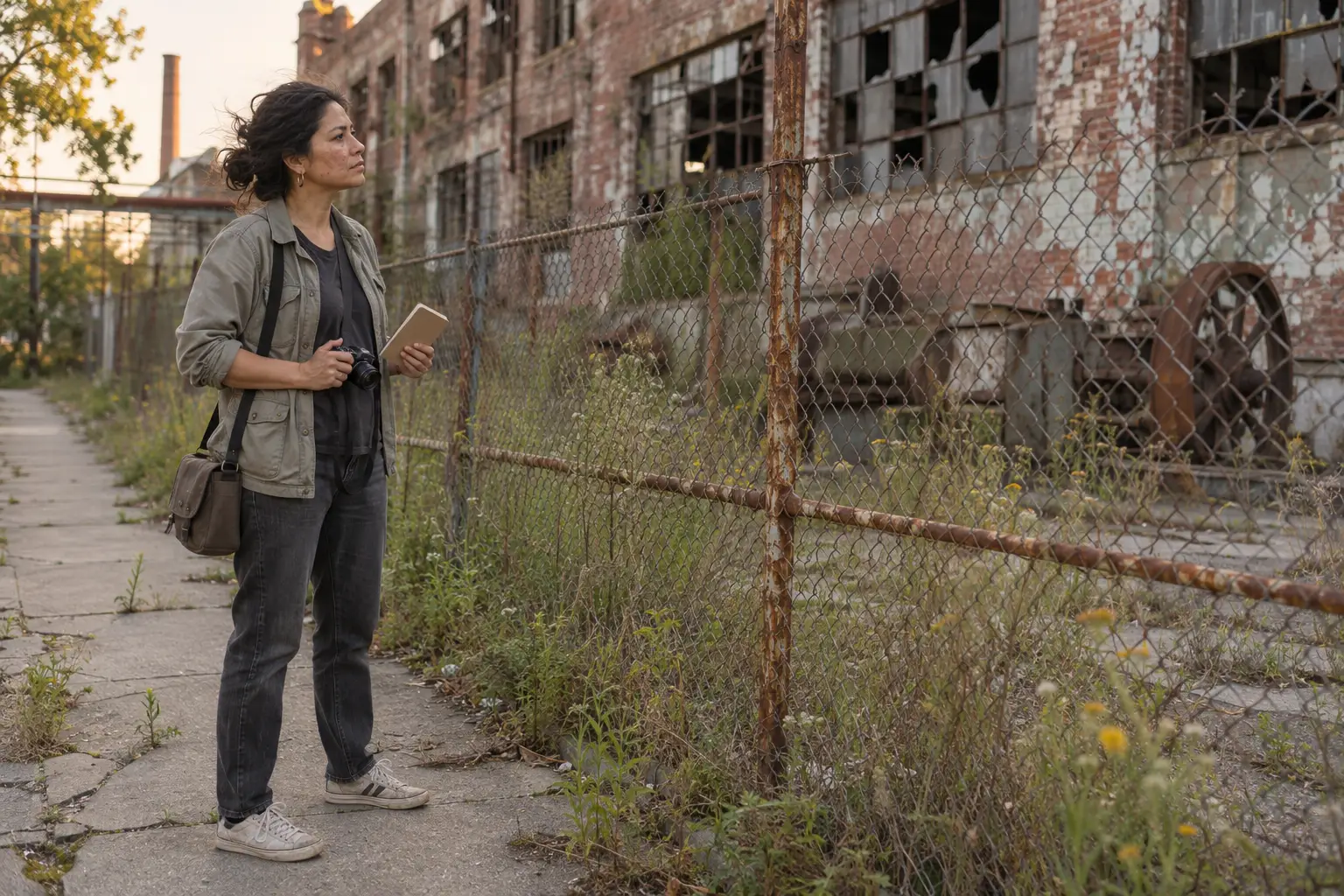
A lawful path starts with intent. If your real interest is visual storytelling, local history, architecture, or adaptive reuse, you may not need physical entry at all. Many strong projects begin from sidewalks, archives, interviews, or approved access rather than improvised visits.
That shift sounds modest. It changes everything. Once you stop treating entry as the goal, better options appear. You can build a repeatable documentation practice without crossing legal lines or putting people at risk. You also gain more control over what your work says and how it is used.
Compare photography research and preservation
Photography captures surfaces and mood fast. Research adds context those images cannot show on their own. Preservation asks a different question again: what should be remembered, protected, or reused? Mixing those aims leads to bad decisions.
WIRED reported that one photographer documented nearly 50 locations across New York City and beyond (WIRED). That example shows range and discipline. It also suggests a better model for most readers: build a body of observation over time instead of chasing one dramatic scene.
Consider three paths before you plan anything:
- Photography if you want to study light, form, texture, and change.
- Research if you want ownership history, civic meaning, or policy context.
- Preservation-minded storytelling if your aim is public memory and cultural value.
Each path asks for different methods. None of them requires guessing that an unlocked door means consent.
Ask where safety and access begin
Safety begins before arrival. Access begins before curiosity turns into action. If either one is unclear, stop there.
WIRED reports that New York City Department of Environmental Protection officials called certain manhole activity "both illegal and extremely dangerous" (WIRED). That is a useful reset because online images flatten risk. They do not show unstable floors, hidden water hazards, air quality issues, security response, or changing conditions since the photo was posted.
A practical rule helps here: verify permission first, then assess whether your project still makes sense. In most cases you will learn something important early. Either lawful access exists and can be arranged under conditions, or it does not and your method needs to change.
How to read a city without entering
Urban explorers are often interested in what a place reveals after the daily routine has moved on. That does not require trespass. Many cities can be read through public edges, transit lines, vacant lots, archive images, and the way people avoid or repurpose space. A sidewalk can tell you a lot if you know what to notice.
This approach also helps people who want to document change without creating harm. You can study decay, reuse, and public memory from lawful vantage points. You can also compare what a place once was with what it is becoming. That is often enough for a strong story.
Look for signs of change
Change shows up in details before it shows up in headlines. Peeling paint, boarded windows, fresh fencing, new signage, and altered foot traffic all tell a story. These clues can be more useful than a dramatic photo because they show process, not just an end frame.
If you are taking notes, keep them plain. Record location, date, weather, visible condition, and any public information you already know. The goal is not to create mystery. The goal is to understand how the city is being revised.
Connect observation to public value
Urban exploration has civic value when it helps people see neglected systems clearly. Done well, it records places before they disappear and raises questions about reuse, waste, and memory. Who gets access to urban history?
That does not mean every hidden place should be exposed online in detail. Public curiosity can also put vulnerable sites at greater risk of vandalism or copycat entry. The ethical task is to document change without turning fragile places into challenges for strangers.
For founders and changemakers, that is the real insight: attention itself can be a form of stewardship when paired with restraint.
Map your next step with purpose
If you are curious about urban explorers because you build brands, products, city programs, or cultural work, start by naming your true goal. Do you want strong imagery? Better research? A heritage angle? A campaign about place? Clear intent keeps romance from overrunning judgment.
The next move should fit that goal. Public-space photography may be enough. Owner-approved access may be possible for some projects. In other cases an archive visit will teach more than any physical visit could. The point is to match method with purpose instead of forcing a dramatic route.
Read change through growth strategy
Places in decline often reveal unmet demand before market language catches up to it. An empty industrial site might signal loss in one story and future housing pressure in another. A sealed tunnel can hint at public fascination with hidden infrastructure and civic trust.
That reading matters in strategy work because people rarely respond only to what is new. They also respond to what is being lost or left behind. Urban exploration shows how memory shapes demand. Adaptive reuse projects understand this well even when public debate lags behind investor interest.
We have seen a similar pattern across digital-age storytelling: careful witnessing often beats louder messaging. If people care about disappearing places enough to document them obsessively, there is probably deeper value under the surface.
Connect AI and technology to city memory
Technology can help record change without encouraging reckless access. AI tools can sort image archives by date or visual feature. Digital platforms can map legal vantage points over time. Communication tools can also add context so images do not drift into myth detached from facts.
That matters because photographs alone can overstate certainty. A dramatic frame looks complete even when key facts are missing: ownership status, current condition, public impact, or whether entry was ever allowed in the first place.
Used well, technology supports memory instead of spectacle. Gray Group International works at that intersection through brands focused on growth, AI communication, and web development. Purpose-driven commerce matters because digital tools shape how people understand place now as much as streets do.
Put these ideas to work
If you are weighing how these ideas fit into your plans, you do not have to work it out alone. Gray Group International partners with founders, executives, and boards who want a clear-eyed read on their options and a realistic path to results. We will tell you plainly what we would do in your position, including the parts that do not involve hiring us at all.
You Might Also Like
Discover more insights in Lifestyle, our full collection of articles on this topic.
Join Disruptors Digest
Insights for a future worth creating. Sustainability, lifestyle, business, and beyond.
Gray Group International is a growth studio helping businesses attract, convert, and retain customers. Our consulting arm, gardenpatch, offers hands-on playbooks and strategy sessions.
