-01.svg "GGI main logo")


By: Tiago Santana - Founder & CEO, Gray Group International • Serial entrepreneur and growth strategist who has built and scaled multiple companies across technology, media, and consulting. Expert in growth strategist and editorial voice for a global think tank building companies that advance the human experience
Consider two schools. One buys impressive music software, then asks teachers to fit lessons around it. The other starts with a simple question: what should learners hear, make, and understand better by the end of term? The first often gets novelty. The second is more likely to get progress.
Music technology helps education when it improves musical judgment, creative confidence, and access to practice. It hurts when teams treat tools as the strategy. The smart move is to judge every platform, device, and workflow by learning value first, then by technical fit, staff readiness, and long-term trust.
Music technology and education through a learning lens
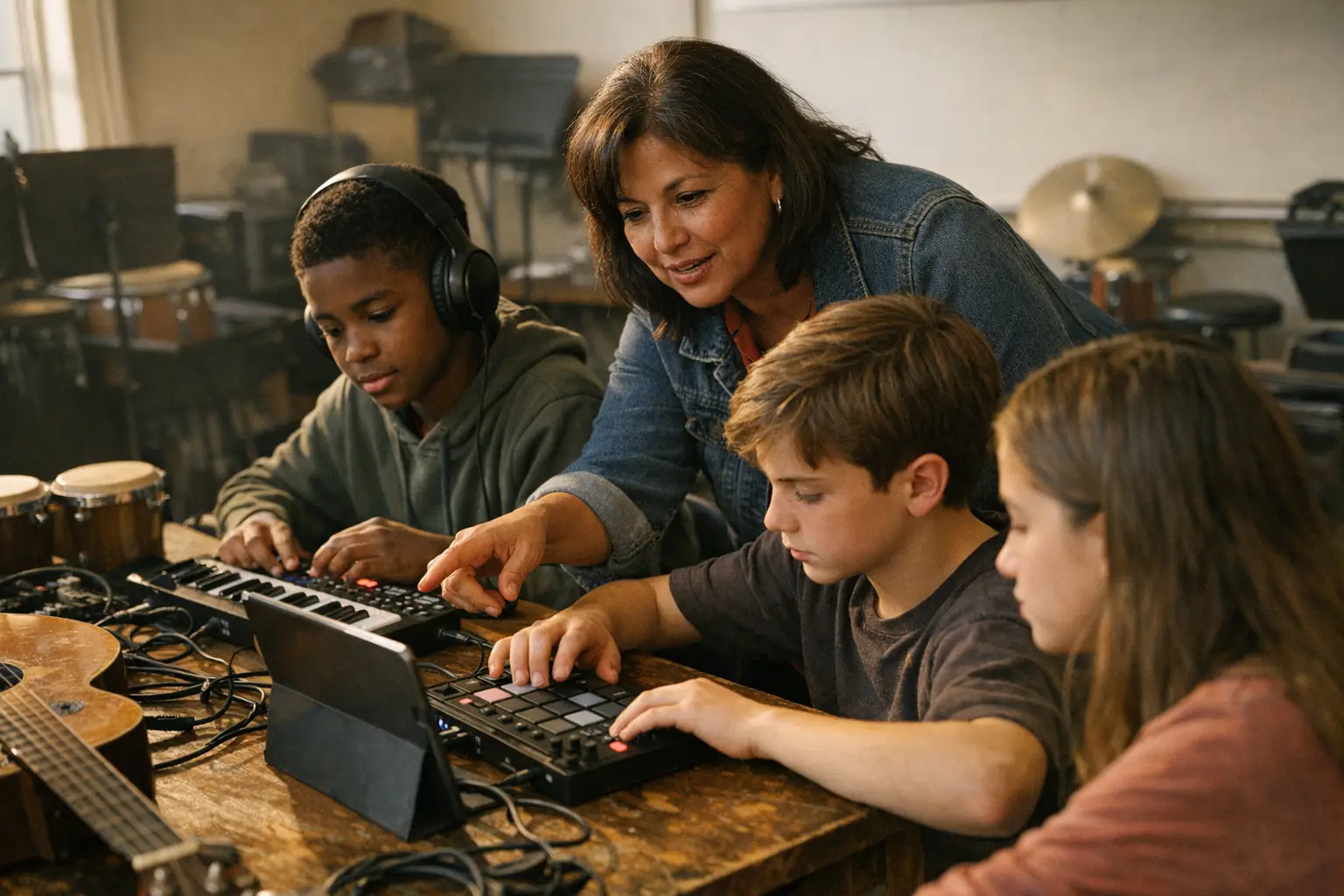
The right way to define this field is broader than software and narrower than hype. It includes digital tools for creating, recording, editing, sharing, performing, analyzing, and teaching music. Yet the real unit of value is not the tool. It is the learning result the tool makes more likely.
That changes how leaders should evaluate the category. A notation app may support theory fluency. A recording setup may build listening discipline. A collaboration platform may strengthen ensemble awareness across distance. If none of those outcomes are clear, the product choice is still premature.
Learning outcomes before feature lists
Start with the musical behavior you want more of. Do learners need stronger rhythmic accuracy? Better arrangement choices? More confident improvisation? Cleaner collaboration between performers and producers? Those questions reveal whether a tool belongs in the room at all.
Feature-first buying often hides weak assumptions. A product can look advanced and still fail basic teaching needs. Many teams forget that music learning depends on repetition, feedback timing, and clear scaffolding. If a workflow adds steps before sound happens, beginners often lose focus before learning begins.
A useful test is simple: can a teacher explain why this tool improves one concrete task by next week? If not, the feature list is probably doing too much work. In music education, friction rarely feels neutral. It usually steals attention from listening and decision-making.
Access and sustainability across contexts
Access is not only about who can log in. It is about whether a learner can keep participating when devices vary, internet fails, headphones break, or home space is noisy. Music tools often assume ideal conditions that many real settings do not have.
Sustainability matters just as much. A program that depends on constant troubleshooting will not last, even if students enjoy it at first. Total cost of ownership includes teacher training time, licensing renewal pressure, device compatibility problems, and support needs. Replacement cycles are part of that picture too.
Interoperability deserves more attention than it gets. In music settings, people move between notation files, audio sessions, cloud folders, classroom systems, and different operating systems fast. When formats do not travel well, teachers spend energy on rescue work instead of instruction.
Digital learning in music classes
Digital music learning succeeds when pedagogy and operations agree. That means lesson design fits classroom reality, support is available when things break, and assessment reflects actual musical work rather than just easy-to-score tasks. The best plans are usually the ones that keep focus on sound, choice, and reflection.
Failure usually looks less dramatic than people expect. Programs do not collapse in one day. They slowly lose trust because setup takes too long, audio routing confuses staff, privacy concerns stay unresolved, or students cannot continue outside school hours. Small points of friction stack up fast in creative environments.
Teacher fit shapes digital transformation
Teacher fit is often the difference between adoption and abandonment. A strong music product can still fail if it assumes every teacher thinks like a producer or engineer. Most educators need workflows they can explain clearly under time pressure.
Training also has to match real teaching patterns. One-off demos rarely help much because music classes are dynamic. Staff need support for common moments: managing latency in group work, moving files between devices, handling mixed skill levels, or assessing process as well as final output.
Consider a hypothetical program leader choosing between two platforms. One offers deep control but requires careful setup each session. The other does fewer things but works reliably across shared devices. For many schools, the second choice creates better learning because consistency beats technical ambition.
AI and technology in practice and authorship
AI adds real promise and real tension. It can help with feedback prompts, practice support, idea generation, transcription aid, or composition scaffolds. Used well, it lowers entry barriers and gives learners faster ways into experimentation.
Still, authorship gets blurry fast. If a system suggests harmony changes or generates a backing track, what exactly belongs to the learner? That question is not academic. It shapes assessment design, teacher expectations, copyright thinking, and student identity as makers.
The strongest approach is to assess decisions, not just outputs. Ask what choices a learner made, revised, rejected, or defended during the process. Authentic assessment works better here because musical growth often shows up in drafts, session notes, reflection logs, rehearsal changes, and collaborative contribution records.
What institutions need to resolve
Builders and institutions face the same core challenge: make digital music learning more human without making it more fragile. That means deciding what should be automated, what should stay teachable by hand, and where complexity is worth asking users to learn. The goal is not to remove effort from learning, but to make effort more productive.
A common mistake is building for imagined excellence instead of normal use. Products often assume quiet rooms, updated hardware, high teacher confidence with audio tools, clean permissions workflows, and stable connectivity. Real adoption depends on what happens when those conditions are not present.
Growth strategy for purpose-driven business
For founders and operators, growth in this category comes from solving one painful job clearly before expanding outward. A product that helps teachers manage creative feedback may matter more than one that offers every production feature under one roof.
Positioning should reflect educational reality rather than tech novelty. Buyers usually need proof of fit across curriculum goals, onboarding effort levels, accessibility needs, privacy expectations, licensing clarity, and handoff between classroom use and independent practice.
That broader view matters to Gray Group International's mission as a growth collective and think tank focused on improving life in the digital age through purpose-driven enterprise. If you are shaping strategy in this space, stronger growth usually starts with one hard question: does your offer reduce friction around meaningful musical learning?
Take the next step
Gray Group International works with leaders who want to move from reading about this topic to doing something about it. Knowing the right approach is only the start; the harder part is building the team, the process, and the decisions that actually shift results inside your own organization. That second part is where most of the value sits, and it is the part we help with every day.
You Might Also Like
Discover more insights in Music, our full collection of articles on this topic.
Join Disruptors Digest
Insights for a future worth creating. Sustainability, lifestyle, business, and beyond.
Gray Group International is a growth studio helping businesses attract, convert, and retain customers. Our consulting arm, gardenpatch, offers hands-on playbooks and strategy sessions.
