-01.svg "GGI main logo")


By: Tiago Santana - Founder & CEO, Gray Group International • Serial entrepreneur and growth strategist who has built and scaled multiple companies across technology, media, and consulting. Expert in growth strategist and editorial voice for a global think tank building companies that advance the human experience
Key takeaways
- Virtual reality replaces the user's surroundings with a digital space; augmented reality keeps the physical world visible and adds digital prompts on top of it.
- Immersion adds value when it changes behavior, understanding, or task performance in ways flat screens cannot match well.
- VR and AR are strong where space, presence, sequence, or embodied practice matter most, and weaker where speed and low-friction access matter more.
- Technical problems in a pilot are often only the visible symptom of weak scoping.
Virtual and augmented reality can help people learn, inspect, and work in new ways. They can also add cost, setup time, and comfort issues. The key is not to start with the headset. It is to start with the task.
Virtual and augmented reality basics
In short: Virtual reality replaces the user's surroundings with a digital space.
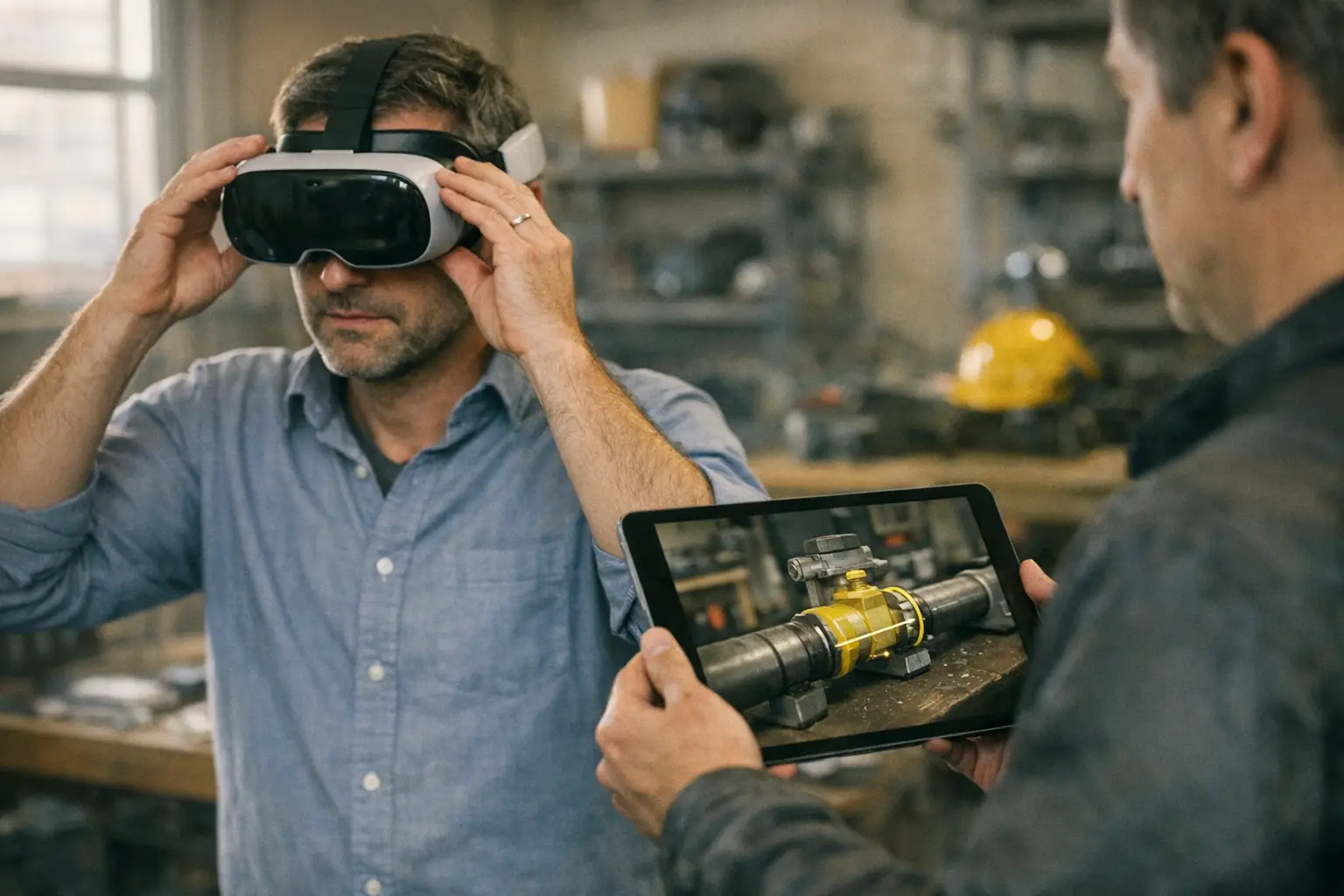
Virtual reality replaces the user's surroundings with a digital space. Augmented reality keeps the physical world visible and adds digital prompts, objects, or instructions on top of it. That difference changes the whole design of a project, from onboarding to support.
A common mistake is treating immersive tech as one broad category. In practice, VR and AR create very different conditions for users. VR can offer more control, but it may also increase setup burden and comfort risk. AR can be easier to fit into daily work, but it depends on the real environment being useful and safe.
How does VR differ from AR in practice?
VR works best when the team needs a controlled simulation. Training for rare events, guided rehearsals, and spatial testing often fit this model because the whole environment can be shaped on purpose. That gives designers more control over what users see and do.
AR works best when the real setting matters more than total immersion. A field worker may need step-by-step prompts while still seeing tools, surfaces, or other people nearby. If the user must stay grounded in the physical world, blocking that world can hurt performance rather than help it.
Where does XR fit in the picture?
XR is an umbrella term, not a strategy. It groups VR, AR, and related immersive systems under one label. That is useful for early planning, but it can hide the key choice if teams stop at the category name.
Use XR as a portfolio term. Do not use it as a shortcut for product decisions. A simple decision matrix helps: full simulation points toward VR, in-place guidance points toward AR, and early strategy scans can use XR as a broad frame.
When immersion adds value
In short: Immersion adds value when it changes behavior, understanding, or task performance in ways flat screens cannot match well.
Immersion adds value when it changes behavior, understanding, or task performance in ways flat screens cannot match well. If it only makes a demo feel futuristic, it is decoration. The question is not whether the experience looks impressive. It is whether it helps people do something better.
Blue Ocean Strategy offers a useful test here. Ask what immersion removes, reduces, raises, and creates compared with normal digital tools. If the answer centers on spectacle instead of task quality or user success, the project may be funding novelty rather than progress.
Can immersive training improve learning outcomes?
It can when spatial understanding or repeated practice matters more than passive viewing. A simulated environment lets users rehearse steps rather than just read about them. That often helps attention and recall because people act inside the lesson instead of watching from outside it.
Still, training gains do not come from graphics alone. Poor onboarding can ruin a smart simulation. A 2021 survey of remote XR research by Jack Ratcliffe and colleagues, posted on arXiv, notes that remote experiments without co-present researchers have not flourished. If training happens remotely, setup support may matter as much as content design.
Do customer experiences gain real value?
Sometimes yes, especially when customers need confidence before choosing something complex or spatial. Seeing placement, scale, or interaction in context can lower uncertainty better than static images do. That can help in areas like home goods, design review, or product selection.
Yet customer-facing immersion has one hard rule: convenience usually wins over cleverness. If users must download too much, learn controls quickly, or tolerate discomfort just to browse, drop-off rises fast. Strong first impressions can hide weak everyday use.
Practical fit for business use
In short: VR and AR do not fit every business need.
VR and AR do not fit every business need. They are strong where space, presence, sequence, or embodied practice matter most. They are weaker where speed, simplicity, and low-friction access matter more than depth of experience.
A practical filter helps: use jobs-to-be-done thinking before any tech discussion starts. Ask what progress the user needs to make under real conditions. Then compare immersive tools against plain video calls, mobile apps, web tools, or physical mockups instead of comparing headsets against each other.
Which use cases suit remote collaboration?
Remote collaboration suits XR only when shared space adds something standard calls cannot provide easily. Spatial review sessions, embodied walkthroughs, or collaborative prototyping may qualify because room-like presence changes how people inspect objects or layouts together.
Even then, caution matters. The same survey observes that remote XR experiments without co-present researchers have not flourished, even though remote methods work well for non-XR research. That suggests limits for distributed immersive work too: variable home setups, device mismatch, uneven onboarding, and weaker experimental control all raise risk.
When does product design benefit most?
Product design benefits most when shape, scale, movement, or placement are central questions early on. Teams can inspect ideas before building physical versions or shipping code into production environments. That can save time when a bad layout would be costly to fix later.
A simple stage-gate works well here: concept review, usability review, and field-fit review. Use immersion only where each stage needs spatial evidence that flat screens cannot show well enough. If another tool answers the question clearly, start there instead.
Risks, pilots, and next steps
In short: Technical problems do happen, but they are often only the visible symptom.
Technical problems do happen, but they are often only the visible symptom. Underneath sits weak scoping: unclear success criteria, poor participant prep, no fallback path when setup fails, and too little thought about user environment differences.
Trust erodes quietly during pilots long before anyone writes a formal postmortem. That is why early planning matters so much.
Are accessibility and comfort bigger risks?
Often yes. Comfort issues can stop sessions before any learning happens. Accessibility barriers can narrow who participates long before leaders review results. If only the most tolerant users finish, the evidence can become skewed.
A common mistake is treating accessibility as phase-two work after concept approval arrives. In immersive projects, it belongs at the start. Comfort, fit, and inclusion shape completion rates and determine whether pilot findings deserve trust at all.
Does research quality shape long-term trust?
Absolutely. If methods are shaky early on, leaders may back projects based on noise instead of signal. The warning in that survey belongs at the center of planning: its authors found remote XR methods less established than remote approaches for non-XR research.
Use a simple evidence ladder before scaling: can users complete setup without live rescue, are outcomes consistent across devices and environments, does immersion improve task performance enough to justify added friction, and can results be replicated in another session format? If the answers are weak, pause before spending more.
What should teams do before a deeper pilot?
A deeper pilot makes sense when the use case depends on space or presence, users can complete setup with limited support, success criteria are concrete, and simpler tools have already been judged not enough for good reasons. Those signals should line up before the budget grows.
If they do not, test whether the use case deserves immersive investment at all, or whether another tool would serve users better. A careful review now can prevent a costly reset later.
Take the next step
Gray Group International works with leaders who want to move from reading about VR and AR to doing something about it. Knowing the right approach is only the start; the harder part is building the team, the process, and the decisions that actually shift results inside your own organization. That second part is where most of the value sits, and it is the part we help with every day.
Discover more insights in Blog, our full collection of articles on this topic.
Join Disruptors Digest
Insights for a future worth creating. Sustainability, lifestyle, business, and beyond.
Gray Group International is a growth studio helping businesses attract, convert, and retain customers. Our consulting arm, gardenpatch, offers hands-on playbooks and strategy sessions.
