-01.svg "GGI main logo")


By: Tiago Santana - Founder & CEO, Gray Group International • Serial entrepreneur and growth strategist who has built and scaled multiple companies across technology, media, and consulting. Expert in growth strategist and editorial voice for a global think tank building companies that advance the human experience
A climate target can fail even when the math looks right. Consider a hypothetical brand buying from small producer groups. It sets a serious emissions goal, then asks suppliers for new data, new practices, and new proof. If support does not follow, the target shifts cost and risk downhill.
Science-based targets in fair trade work only when climate ambition and producer protection are designed together. In plain terms, that means setting emissions goals that fit climate science, then building sourcing rules, contracts, data systems, and supplier support that make those goals possible without weakening livelihoods.
Origins of science-based targets in fair trade
The idea joins two different promises. One promise is climate discipline. A company should cut emissions in line with what science requires, not what feels easy. The other promise is fairer trade. Producers should have better terms, more voice, and safer conditions.
Those promises meet in the supply chain. That is where most teams discover the real challenge. A target can look clear at headquarters and still break down at farm, workshop, processor, or cooperative level. Fair trade adds an ethical test to decarbonization. Who carries the burden of change?
A common mistake is treating climate work and ethical sourcing as separate programs. One team tracks emissions boundaries and reporting rules. Another team manages traceability and supplier relationships. On paper, both seem fine. In practice, they shape the same decisions about price, timing, proof, and risk.
What science-based targets require in sourcing
In sourcing, science-based targets require more than a public goal. They need a defensible boundary around emissions sources and a view of where the biggest hotspots sit. They also need a method for tracking progress over time. For fair trade products, much of that footprint often sits outside direct operations.
That changes the job for procurement and operations teams. They cannot just ask for lower-carbon inputs in general terms. They need crop-specific or process-specific actions that suppliers can actually carry out. For some categories, that may mean cleaner processing energy. For others, it may mean input management, transport changes, or less waste.
Perfect data rarely appears first. Stronger programs usually start with materiality judgments and workable estimates. Then they improve data quality over time. Waiting for full precision often delays action. False precision creates a different problem. It can make weak evidence sound stronger than it is.
Why producer livelihoods shape climate progress
Producer livelihoods are not a side issue here. They are part of whether the target has any chance of holding up over time. If a supplier faces lower margins, more paperwork, or higher transition costs with no support, adoption usually slows or stays shallow.
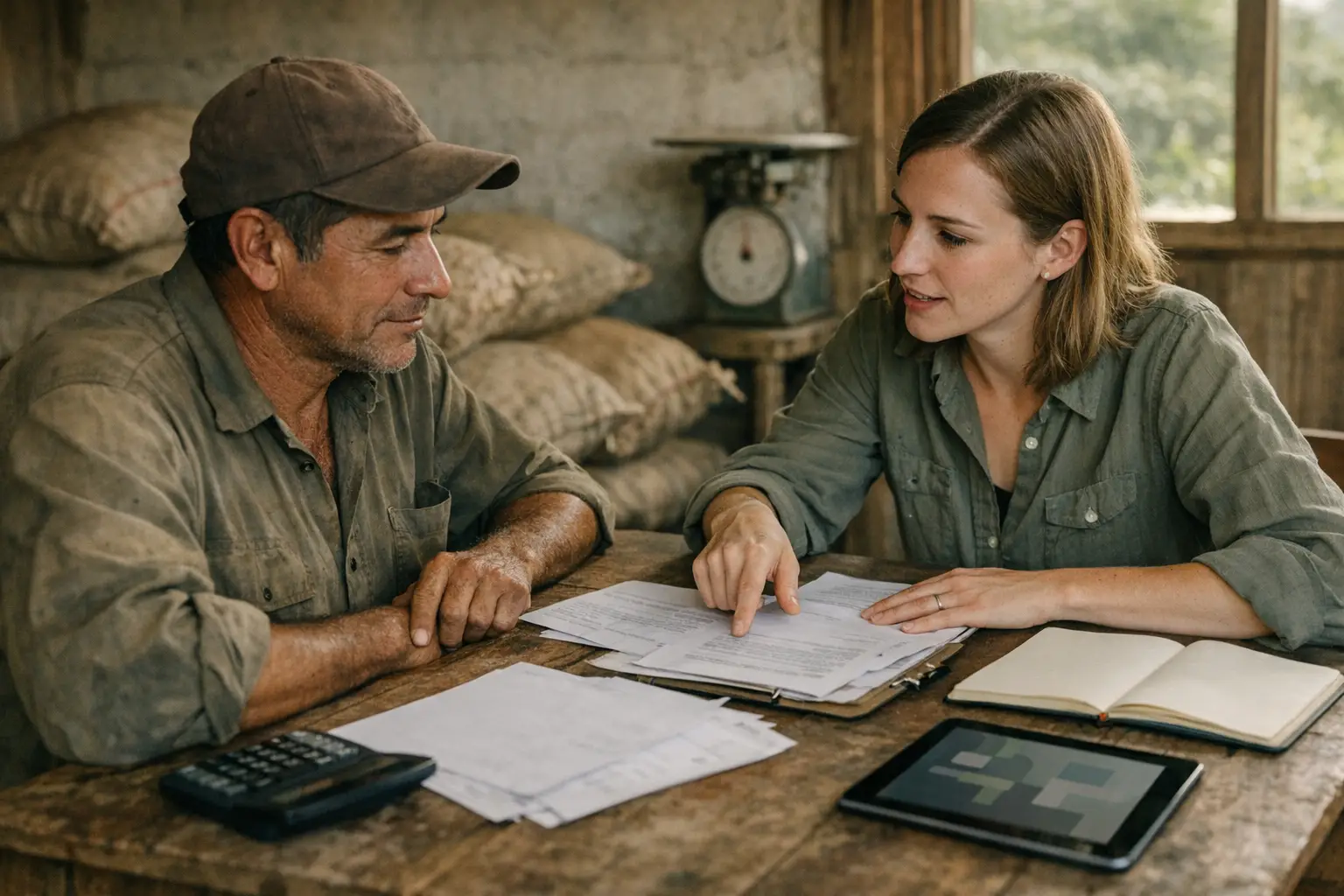
Consider a hypothetical cooperative asked to change drying methods and collect new field records at once. The climate case may be sound. Even so, if contract terms do not improve and training arrives late, the plan becomes fragile fast. The obstacle is not resistance to climate action. It is uneven capacity and uneven risk sharing.
Fairness shows up in practical design choices. Longer contracts can help suppliers plan changes with less fear. Pre-financing can reduce cash strain during transition periods. Participatory planning matters too, especially where local conditions vary widely. People closest to production often know which changes will hold and which will not.
The turning point as climate and trade converge
Climate commitments and sourcing commitments now collide in daily operations. Procurement teams need lower-emissions supply options. Sustainability teams need claims they can defend. Brand teams need language that will not outrun the evidence. Those pressures are no longer separate.
The turning point comes when leaders stop asking whether they should combine them and start asking how to do it without breaking trust. Fair trade does not automatically mean low carbon. Decarbonization does not automatically mean more justice either. Once you accept both truths, better design choices become possible.
Where sustainability meets social impact tradeoffs
Most tradeoffs appear long before public reporting does. They show up in who pays for traceability tools, who spends time collecting activity data, and who absorbs lower yields during practice changes. They also show up in who gets blamed when evidence remains incomplete.
Many weak programs treat producers as reporting subjects instead of transition partners. Then forms arrive before support does. Audit demands rise before purchasing behavior changes. Claims get bolder while local proof stays patchy. That is usually where trust starts to erode.
A better approach starts with context as much as carbon. Which stages create the biggest emissions? Which interventions could reduce them without harming income security or yield stability? Which suppliers need finance, equipment access, or simpler reporting before any pathway becomes real? Those questions tend to matter more than polished slogans.
How AI and technology improve supplier data
Technology helps most when it reduces burden instead of adding another layer of admin work. Good systems can combine supplier records, processor data, transport assumptions, and remote observation tools where suitable. They can also bring traceability signals into one clearer picture.
AI can help clean messy supplier inputs, flag gaps in records, group similar production patterns, and surface hotspots faster than manual review alone would allow. That matters in fragmented supply chains where many producers lack time or tools for detailed reporting every cycle.
Still, technology does not solve governance on its own. Data ownership matters. Consent matters too. Language access matters just as much as software design does. If digital systems extract information without sharing value back to producers, they may improve dashboards while weakening relationships on the ground.
What it means for purpose-driven business now
For purpose-driven businesses, the main decision is not whether to set an ambitious target or protect supplier livelihoods. You need both by design or neither will stay credible for long.
That means building a phased operating model before making strong claims everywhere at once. First, map the value chain. Then identify likely emissions hotspots, check traceability depth, review producer economics and transition risks, and set milestones for measurement, supplier support, governance, and reporting.
Most organizations do not need complexity first. They need coherence first.
Growth strategy for credible climate claims
Credible claims come from disciplined scope choices and restrained language. Say what has been measured directly. Say what has been estimated from reasonable assumptions. Say what remains uncertain or not yet covered fully.
Consider a hypothetical retailer buying from several purpose-led suppliers with very different data maturity levels. The smart move is not broad customer-facing messaging right away. A better path is staged substantiation: classify suppliers by readiness, set minimum documentation rules, support improvement efforts, then reserve stronger claims for lines with defensible evidence.
That is also where growth strategy gets practical instead of performative. Strong claims can build trust only if commercial systems support them. If buyers still reward only lowest short-term cost or last-minute demand swings, even thoughtful climate plans tend to stall upstream.
Take the next step
A single conversation with Gray Group International is often enough to see which parts of what you have just read apply to your situation and which do not. We start with where you are today, not with a framework, and we leave you with a short list of practical next steps you can run on your own or with us. There is no deck and no pitch, just a working session with people who have done this before.
You Might Also Like
Discover more insights in Sustainability, our full collection of articles on this topic.
Join Disruptors Digest
Insights for a future worth creating. Sustainability, lifestyle, business, and beyond.
Gray Group International is a growth studio helping businesses attract, convert, and retain customers. Our consulting arm, gardenpatch, offers hands-on playbooks and strategy sessions.
