-01.svg "GGI main logo")


By: Tiago Santana - Founder & CEO, Gray Group International • Serial entrepreneur and growth strategist who has built and scaled multiple companies across technology, media, and consulting. Expert in growth strategist and editorial voice for a global think tank building companies that advance the human experience
Music technology can do more than play sound. It can help people listen, create, share, and take part in culture. But when products are hard to use with assistive tools, some people get left out before the music even starts. Accessibility in this space means designing for full participation across listening, creation, performance, distribution, and community.
In This Article:
- Set the inclusion baseline
- Prioritize what blocks participation
- Design for the whole experience
- Build accountability into the organization
- Keep the work moving
- Let's connect
- You Might Also Like
In This Article:.
- Set the inclusion baseline
- Prioritize what blocks participation
- Design for the whole experience
- Build accountability into the organization
- Keep the work moving
- Let's connect
- You Might Also Like
For teams building music products, the main question is not whether accessibility matters. It is whether the product lets more people take part without extra friction.
Set the inclusion baseline
Accessibility in music tech is not a final polish step. It belongs in the product from the start. If your tool sits between sound and human experience, then access changes whether people can use it at all, not just how pleasant it feels. That is why teams need a clear baseline before they talk about features or launch dates.
A strong baseline starts with one simple question: who gets the full experience, and who gets a reduced one? In music products, that answer often changes based on how a person listens, what device they use, or how they move through setup. When teams ignore that, they may ship something that works well for many users but blocks others at the point that matters most.
Define access across the music journey
Access starts before playback and continues after it. A person may need support while discovering music, pairing a device, joining a live event, or sharing their own work. If one step fails, the whole experience can break down. That is why access should be mapped across the full journey, not only inside the player.
For example, WIRED reports that audio-streaming technology for hearing aids and cochlear implants can help people with hearing loss enjoy music, games, and TV without missing content (WIRED). That example shows how direct audio access can change whether media feels open or closed. It also shows that accessibility is not only about compliance. It is about whether people can actually participate.
Map user needs beyond compliance
Compliance can set a floor, but it does not tell you what a good experience feels like for someone using assistive listening tools. A product may meet formal rules and still be difficult to use in daily life. That is why teams should separate two questions: are we meeting obligations, and are people truly able to take part? Those answers are often different.
A music service might technically support a feature, but the setup may be confusing, the labels may be unclear, or the support page may leave out the steps that matter. The result is an adoption gap. The capability exists, but the person who needs it never reaches it. That is a product problem, not a user problem.
Prioritize what blocks participation
Most teams do not need more broad statements about inclusion. They need a way to decide what to fix first. Start where exclusion is most likely to block the core job of the product. For many music tools, that means hearing access, device support, and setup clarity before anything else.
The research in the source material points in one direction: direct streaming support can improve media experiences for people with hearing loss. That should shape roadmap planning. When access affects whether users can enjoy content at all, it deserves early attention, not a later patch.
Assess hearing access in streaming and devices
Begin with the path between source audio and supported devices. Ask whether the product makes that path clear, reliable, and easy to set up. If users rely on hearing aids or cochlear implants, confusion at this stage can erase value before playback begins.
A practical review should include onboarding copy, device guidance, troubleshooting flows, audio controls, and support pages. Many failures happen outside the core player because no one owned the full experience from discovery to listening. Accessibility problems often appear in small moments, but those moments can decide whether the product is usable.
Test AI and adaptive tools with disabled users
Do not assume an intelligent feature is an inclusive one. AI communication tools, recommendation systems, voice features, and adaptive interfaces can all create barriers if disabled users were not included in testing from the beginning. A useful rule is simple: test with the people whose access depends on the decision.
That means real-world testing with users of hearing aids or cochlear implants when your product affects listening conditions shaped by those devices. Without that input, teams may optimize for average behavior and miss real needs that are not edge cases at all. Inclusive testing is part of product quality.
Design for the whole experience
Music access is not only about one screen or one feature. It includes discovery, setup, playback, support, and social participation. If any part of that chain is hard to use, the experience becomes narrower than it should be. Teams that think in full journeys are more likely to build products people can actually rely on.
This wider view also helps teams spot hidden barriers. A setting that looks simple to engineers may still be unclear to users. A feature that sounds helpful in a meeting may create extra steps for someone who already depends on assistive hardware. The best design is often the one that removes confusion before it starts.
Connect onboarding, support, and community
Onboarding is often where accessibility succeeds or fails. If setup steps are too technical or the language is too vague, users may never reach the part of the product that matters most. The same is true for support content. If help pages assume too much, people can be stuck without a clear path forward.
Community spaces matter too. Music products are often tied to events, creator groups, or fan spaces. If those touchpoints are not accessible, the product may exclude people even when the core listening tool works well. That is why teams should treat support and community design as part of accessibility, not as separate extras.
Make creator tools more usable
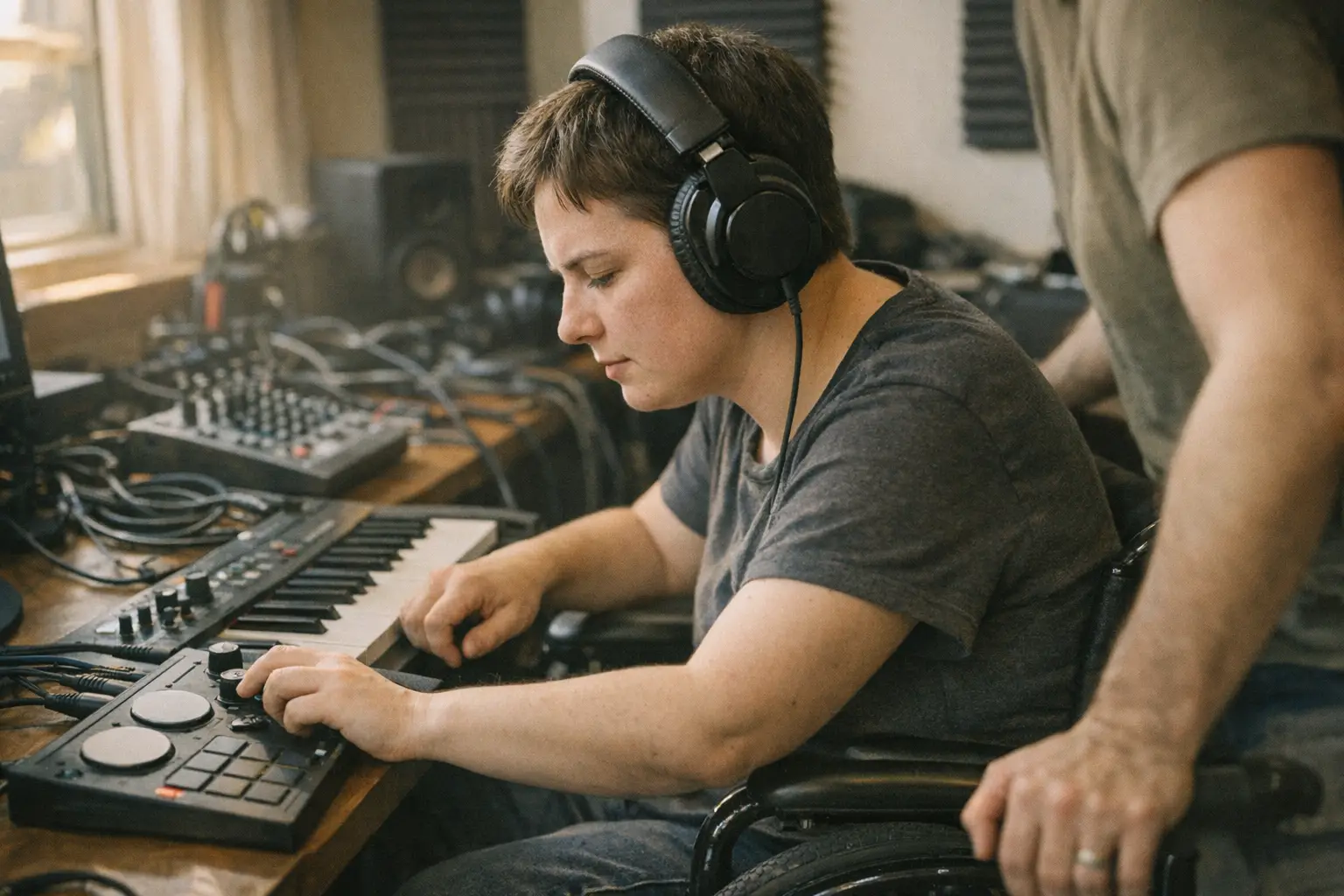
Accessibility also matters for people who make music, not only people who consume it. Creator tools should support clear controls, predictable workflows, and settings that do not require expert knowledge to use. If a person cannot easily edit, monitor, or share their work, the tool is limiting participation.
This is especially important when products add new layers like AI assistance or automated mixing. These tools may be useful, but they should not hide key controls or create extra barriers. A good test is whether a creator can still understand and manage the process when they use assistive technology or a different input method.
Build accountability into the organization
Product fixes alone will not solve accessibility if no one owns it. Inclusion also lives in hiring, partnerships, event planning, feedback systems, and leadership decisions about what counts as done. If no one is responsible, the work can fade into the background.
The Recording Academy states that diversity, equity, and inclusion are part of its core values and apply across every area of the organization. That approach matters because it treats inclusion as an operating principle, not a one-time project. Music companies can use the same mindset when they set goals and review progress.
Link growth strategy to social impact
Growth is not neutral if some users are left out of the experience. In music technology, accessibility affects reach, trust, and retention. If direct audio access changes whether people can enjoy content without missing anything, then accessible design also shapes audience quality and community health.
That is why accessibility should be part of strategy, not just branding. A product that works for more people can support wider participation and stronger loyalty. It can also help teams make clearer choices about what kind of experience they want to build and who it is meant to serve.
Keep the work moving
Accessibility improves when teams treat it as ongoing product work, not a one-time review. That means checking features after launch, collecting feedback from disabled users, and revisiting support content when the product changes. Small updates matter because music products often depend on many linked steps, and one weak link can interrupt the experience.
It also helps to write down clear ownership. When teams know who handles device support, who reviews onboarding language, and who tracks user reports, the work is easier to maintain. This kind of structure is simple, but it makes it more likely that accessibility stays visible through future releases.
Measure what users can actually do
Metrics should focus on real use, not just feature counts. It is not enough to say a tool has a setting if users cannot find it or do not understand it. Measure whether people can complete setup, listen without confusion, and use support when they need it.
Those checks can reveal where a product is working in theory but failing in practice. They can also help teams compare fixes and choose the ones that reduce friction the most. In music technology, that practical view is often the difference between a feature that exists and a feature that helps.
Let's connect
Gray Group International works with leaders who want to move from reading about this topic to doing something about it. Knowing the right approach is only the start; the harder part is building the team, the process, and the decisions that actually change results inside your own organization. That second part is where most of the value sits, and it is the part we help with every day.
You Might Also Like
If you want more practical reading, these pieces cover related beginner topics in a clear way. They are useful if you like short guides that explain a process step by step and keep the language simple.
- A Beginner's Guide to Income Tax Deductions
- The Complete Guide to Income Tax Deductions
- Understanding Income Tax Deductions
- A Beginner's Guide to Tax Filing for the Self Employed
- Tax Withholding on a Paycheck: A Step-by-Step Guide
These links fit readers who want straightforward explanations and practical next steps.
Discover more insights in Music, our full collection of articles on this topic.
Join Disruptors Digest
Insights for a future worth creating. Sustainability, lifestyle, business, and beyond.
Gray Group International is a growth studio helping businesses attract, convert, and retain customers. Our consulting arm, gardenpatch, offers hands-on playbooks and strategy sessions.
