-01.svg "GGI main logo")


By: Tiago Santana - Founder & CEO, Gray Group International • Serial entrepreneur and growth strategist who has built and scaled multiple companies across technology, media, and consulting. Expert in growth strategist and editorial voice for a global think tank building companies that advance the human experience
Key takeaways
- Farm-to-table is meaningful only when an operator defines terms like local, fresh, and seasonal in public and in procurement.
- Specific claims, such as same-day harvest, signal stronger sourcing discipline than broad feel-good language.
- Strong programs work because menus flex with supply reality, not because branding sounds virtuous.
- Seed-to-table thinking pushes leaders upstream, toward crop choices, soil questions, and longer supplier relationships.
Farm-to-table dining means shortening the path between producer and plate, then backing that claim with clear sourcing rules, flexible menus, and honest proof. Its value is not the phrase itself. It comes from whether an operation can define origin, adapt to seasonality, and explain tradeoffs without hype.
In This Article:
- Key takeaways
- Farm-to-table in plain English
- Farm-to-table dining explained through menu design
- How does the model work behind the scenes?
- What does this mean for operators and diners?
- What to watch
Farm-to-table in plain English
In short: Farm-to-table is a sourcing model with fewer handoffs between grower and guest.
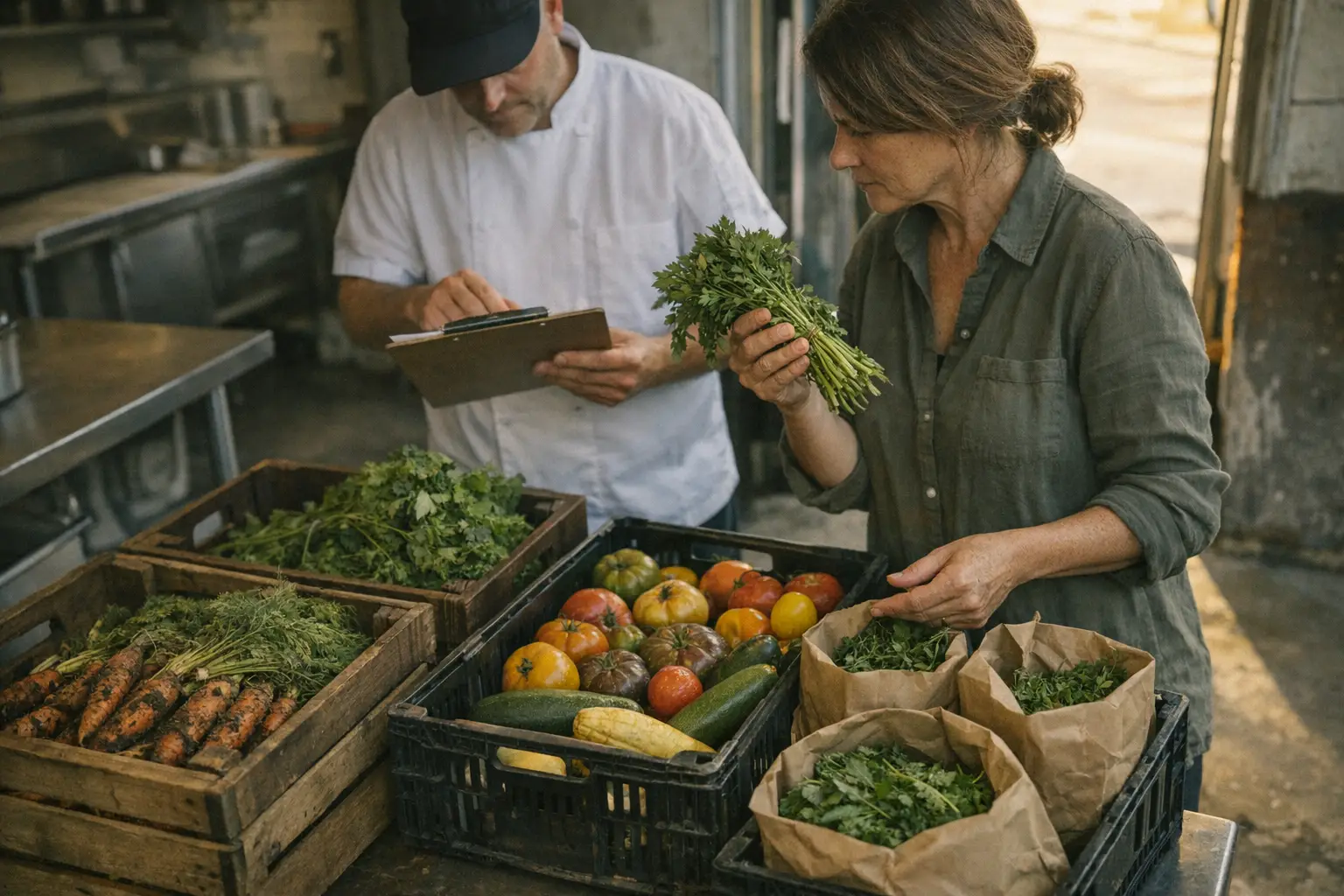
Farm-to-table is a sourcing model with fewer handoffs between grower and guest. That sounds simple, but the meaning changes when you look at the workflow behind it. Fewer steps matter only if the restaurant can still explain where food came from and how that affects the meal. If buyers, chefs, and service staff use different definitions of local or fresh, guests receive a story that procurement cannot fully support.
A common mistake is treating the phrase as a style instead of an operating choice. Teams often start with mood and decor, then fill in the sourcing story later. That order creates trouble fast. When the language is vague, the promise becomes hard to defend. A clear farm-to-table program starts with rules, then menu design, then guest-facing copy.
Why shorter supply chains matter
Shorter supply chains can improve visibility more than they improve image. The real gain is not romance. It is knowing who grew the food, when it arrived, and what changes when weather or harvest quality shifts. That matters for trust, planning, and food quality. It also helps teams respond when supply changes without making confusing claims.
National Geographic asked a simple question in 2015: if people say they support local farmers and ranchers, what does local actually mean? That question still matters because unclear distance claims create expectation gaps before anyone takes a first bite. Guests do not need perfect simplicity. They need language that matches the sourcing model closely enough to feel honest.
Farm-to-table dining explained through menu design
In short: Menus are where sourcing promises become visible.
Menus are where sourcing promises become visible. They show whether sourcing shapes decisions or only decorates them. A fixed menu suggests stable supply. A changing menu signals that seasonality and delivery timing influence what gets served. In practice, the menu is often the fastest way to test whether farm-to-table is real.
A common mistake is promising highly fresh ingredients while keeping descriptions frozen for weeks. Once substitutions happen without updates, trust starts to slip. Clear menu systems help teams stay aligned with what is available now, not what was available last month. That kind of discipline makes the guest experience more believable.
How menus reflect sourcing choices
Menu design is one of the clearest signs of sourcing discipline. If ingredients shift with harvest conditions, the menu should shift too. That does not mean a restaurant must rewrite everything each day. It does mean the language should reflect real supply patterns rather than a static brand script.
A simple comparison helps:
| Menu approach | Sourcing signal | Operational risk |
|---|---|---|
| Fixed year-round dishes | Low visibility into seasonality | Higher risk of overclaiming |
| Seasonal rotations | Moderate sourcing discipline | Medium planning burden |
| Daily flexible dishes | Strong freshness signal | Higher coordination burden |
When is farm-to-table meaningful?
Farm-to-table becomes meaningful when claims are testable. Diners do not need every invoice or delivery log. They do need language that matches reality closely enough to trust what they are being told. A practical credibility check has three parts: Is the claim defined? Can staff explain it? Can operations prove it internally?
If any answer is no, the claim is weaker than it sounds. That is why broad phrases such as farm fresh can create problems. They sound positive, but they do not tell guests much about distance, timing, or source. Clearer claims tend to be more useful for both customers and teams.
How does the model work behind the scenes?
In short: Behind the scenes, farm-to-table is less about sentiment and more about coordination.
Behind the scenes, farm-to-table is less about sentiment and more about coordination. Kitchens need backup plans, buyers need shared rules, and service teams need current information when ingredients change. Without that structure, even honest operators can drift into confusing claims. The work is practical and repetitive, not glamorous.
Weather shifts, deliveries move, quality varies, and substitutions become normal. A strong farm-to-table model expects that reality. It does not pretend every item will always be available. Instead, it builds systems that let the restaurant adjust while staying truthful to the guest.
Where do producer partnerships add value?
Producer partnerships add value when they improve visibility and planning together. Closeness alone does not solve complexity. The real benefit comes from knowing availability patterns early enough to shape prep lists and dish design. When that happens, the menu can respond to supply conditions without feeling disjointed.
That approach also encourages better upstream thinking. Dan Barber's idea of Seed to Table, reported by National Geographic in 2015, points toward crop choices, soil questions, and longer supplier relationships. The useful shift is strategic: ask not only who grows your produce, but which crop choices your menu rewards over time.
Can same-day harvest change menu quality?
Yes, but only if operations can keep pace with the promise. Same-day harvest can tighten flavor and texture windows for highly perishable produce. It can also make a dish easier to explain because guests understand what picked today means without much effort. That kind of specificity can strengthen trust when it is used carefully.
At the same time, same-day language raises the execution bar. One late update can undo weeks of careful storytelling. If your team wants help designing traceability rules or seasonal menu systems that hold up under growth pressure, schedule a strategy conversation with Gray Group International.
What does this mean for operators and diners?
In short: For operators, farm-to-table is a claim management problem wrapped around food values.
For operators, farm-to-table is a claim management problem wrapped around food values. For diners, it is a trust question: does the stated sourcing model explain what is on the plate today? The answer does not need to be perfect, but it should be clear. Honest limits often build more trust than oversized promises.
This is also where sustainability language needs care. Farm-to-table can support better sourcing habits, but it does not automatically equal sustainability. Scope matters. If a team cannot define local or direct-sourced internally, broader environmental claims will likely outrun evidence.
How should sustainability claims be measured?
Start with claim scope before impact scope. Many sustainability statements fail because they jump past basic definitions of sourcing practice. If you cannot explain what counts as local, fresh, or direct-sourced internally, public language will become hard to defend.
The wider context still matters. An arXiv review notes that global food systems face the urgent challenge of supplying sustainable, nutritious diets under growing demand. That means farm-to-table should be treated as one design choice inside a larger system, not as an automatic proxy for sustainability.
Take the next step
Gray Group International works with business leaders to turn insight into action. Reading about the right approach is one thing; building the team, processes, and decisions that actually move metrics inside your specific organization is another. That second part is where most of the value lives, and it's where we focus.
Every engagement starts with a working session, not a deck. We listen to where you are today, look at the data and constraints with you, and propose the next two or three concrete moves that we believe will produce the most leverage. You leave with a plan you can act on whether or not you continue to work with us.
What to watch
In short: Watch for drift between message and procurement reality.
Watch for drift between message and procurement reality. Most weak farm-to-table programs do not fail because values are wrong. They fail because definitions blur over time while menus and marketing stay frozen. The fix is regular review, especially as seasons change.
A claim that was accurate in peak harvest may become sloppy later if supply patterns shift and copy does not. That is why teams should revisit language at each seasonal turn. What matters is not how attractive the wording sounds, but whether it still matches current sourcing.
Which tradeoffs shape scale and seasonality?
Scale increases coordination load faster than most teams expect. More sites mean more variation in deliveries, storage capacity, substitution rules, and staff training needs across locations. Seasonality adds another layer because it changes what can be promised with confidence.
A common mistake is assuming summer messaging will still fit winter conditions just because brand positioning stays constant year-round. In most cases, scale-friendly farm-to-table models rely on tighter definitions and more flexible menus rather than bigger promises.
How can buyers avoid vague marketing?
Buyers can avoid vague marketing by writing internal definitions before writing public copy. Three short rules help most: define local by geography or category; define freshness by time window where possible; define who approves wording changes when supply changes.
That sounds basic because it is basic, yet it is often skipped. If a team cannot audit a phrase against purchasing records quickly, it should not appear on a menu or website yet. Clear rules keep marketing, sourcing, and operations aligned.
Discover more insights in Blog — explore our full collection of articles on this topic.
Join Disruptors Digest
Insights for a future worth creating. Sustainability, lifestyle, business, and beyond.
Gray Group International — a growth studio helping businesses attract, convert, and retain customers. Our consulting arm, gardenpatch, offers hands-on playbooks and strategy sessions.
