-01.svg "GGI main logo")


By: Tiago Santana - Founder & CEO, Gray Group International • Serial entrepreneur and growth strategist who has built and scaled multiple companies across technology, media, and consulting. Expert in growth strategist and editorial voice for a global think tank building companies that advance the human experience
Key takeaways
- Accessible transportation is the full system that lets people travel safely and with dignity.
- Safety gaps usually appear where one part of a trip hands off to another.
- Choose fixes by rider risk, trip volume affected, independence gained, and cost.
Accessible transportation means more than ramps and compliance checks. It means a rider can plan a trip, reach the stop, board safely, handle a delay, and arrive without avoidable harm.
What is accessible transportation?
In short: Accessible transportation is the full system that lets people travel safely and with dignity.
Accessible transportation is the full system that lets people travel safely and with dignity. That includes sidewalks, stops, stations, vehicles, apps, ticketing tools, announcements, and staff support. If someone can plan the trip but cannot finish it, the system is not truly accessible. That is why the whole route matters, not just the vehicle or platform.
This issue reaches far beyond a narrow group. The World Health Organization's disability fact sheet estimates that 1.3 billion people experience significant disability, about 16% of the world's population. The United Nations projects that the global population aged 65 and older will reach 2.2 billion by the late 2070s. Accessible systems also help people with temporary injuries, parents with strollers, and travelers carrying luggage.
Who benefits beyond disability users?
Many teams still picture only wheelchair users when they hear the term accessible transportation. That view misses a wide range of riders. Older adults with balance issues, blind riders who need audio cues, deaf riders who need visual alerts, and people with cognitive disabilities who need clearer wayfinding all benefit from the same design choices.
The broader benefit matters because good access lowers friction for everyone. Level boarding speeds up boarding. Clear signs reduce missed stops. Simpler instructions reduce confusion at pickup points.
Why does dignity matter in mobility?
Dignity is not a soft extra. It changes whether people can work, attend appointments, and move through public space without stress. When transport breaks down, missed medical visits can rise and job access can shrink. The Bureau of Transportation Statistics, using National Household Travel Survey data, reports that people age 18 to 64 with travel-limiting disabilities made fewer trips per day in 2022 than people without them (1.7 v. 2.3 trips).
Dignity also shows up in small details. Did the app work with a screen reader? Was the outage posted before the rider left home? Was securement done respectfully? Riders need more than legal access. They need predictable travel so they are not forced to explain lateness caused by failures they could not control.
Where do safety gaps appear today?
In short: Safety gaps usually appear where one part of a trip hands off to another.
Safety gaps usually appear where one part of a trip hands off to another. A low-floor bus does not help if the sidewalk to the stop has no curb ramp. An accessible station fails if elevator outages are not posted in real time. These weak points often seem small, but they stack up across the trip and create serious risk.
The pattern is well known. People with disabilities face more transportation barriers overall, and the same BTS report notes that many of them cope by asking others for rides or cutting back day-to-day travel. Rider complaints tend to involve not only vehicles but also service denials, stop announcements, maintenance lapses, and poor training.
How do sidewalks block safe access?
Sidewalks are often the first failure point. Missing curb ramps force wheelchair users into traffic lanes. Cracked pavement raises fall risk for cane users and older adults. Poor snow clearance can turn an accessible route into a dead end during morning rush hour. These are not small problems. They decide whether the trip can begin at all.
A common mistake is to treat sidewalks as someone else's job and then call the transit system compliant. One missing curb ramp can make an otherwise accessible bus route unusable. If the first mile fails, the rest of the network does not matter.
Why do stations fail real usability?
Stations often meet minimum code while still failing during normal disruptions. Elevator downtime is the clearest example. Riders change routes based on lift status in real time, so step-free access only works when the data is current and the repair process is fast. A code-compliant station that cannot stay open is not truly usable.
Teams should treat station access like a reliability problem. Track outage minutes per asset. Publish status openly. Set repair response targets in vendor contracts.
Which 7 fixes improve safety right now?
In short: Seven fixes usually produce faster safety gains than large capital plans alone: upgrade curb ramps and crossings, add audio and visual wayfinding, simplify ticketing and apps, strengthen driver training, publish live accessibility data, improve lift and elevator uptime contracts, and use better metrics with a monthly review.
Seven fixes usually produce faster safety gains than large capital plans alone: upgrade curb ramps and crossings, add audio and visual wayfinding, simplify ticketing and apps, strengthen driver training, publish live accessibility data, improve lift and elevator uptime contracts, and use better metrics with a monthly review. These changes work because they reduce risk at the points where trips most often break.
The best order is not always the biggest budget item. Fix the points that affect the most trips first. Then fix the points where failure causes physical danger. After that, fix the points that remove dependence on staff. This approach gets real results faster than waiting for one large rebuild.
Fix 1: upgrade curb ramps and crossings
Curb ramps and crossings reduce direct injury risk and often open up existing transit capacity at the same time. Grade changes and detectable warnings are core parts of pedestrian access because they control whether riders can enter the network safely. Without them, even a well-run system can be blocked at the edge.
Teams should map high-friction corners before spending broadly citywide or campus-wide.
Fix 2: add audio and visual wayfinding
Audio and visual wayfinding close major sensory gaps quickly. Blind riders need audible stop calls or beacon cues where appropriate. Deaf riders need clear screens for delays and platform changes at every key decision point. Both groups need information before they reach the point of failure.
Good wayfinding is also about layout and timing. Screens need contrast. Signs need clear sight lines. Messages need plain language. A common failure is installing the technology and then placing it where riders cannot easily see or hear it. Test signs during crowded boarding periods, not in an empty hallway.
Fix 3: simplify ticketing and apps
Bad ticketing creates hidden exclusion because riders may never reach the vehicle stage at all. Many websites and apps still fail basic accessibility checks, which means riders can be blocked before they even leave home. A common mistake is buying MaaS software without testing it with screen readers or plain-language tasks like changing a booking during disruption.
Fix 4: strengthen driver training
Driver behavior can make expensive equipment either trustworthy or useless. Training must cover securement procedures, respectful communication, exact stopping positions near curb cuts or bridge plates, and de-escalation during delays. It should also cover how to assist without grabbing mobility devices or making unsafe assumptions.
Many agencies focus training hours on general safety but underweight disability interaction scripts. A single bad encounter can shape how a rider sees the service for a long time.
Fix 5: publish live accessibility data
Live data matters because access fails in real time, not just on a schedule. Riders need to know whether a lift is down, whether a route is detoured, and whether an alternate entrance is usable before they leave home. If that information is missing, the system creates avoidable risk and wasted trips.
This is one of the lowest-cost fixes with one of the largest trust benefits. It also supports better planning for staff and customers. The more accurate the data, the fewer surprise failures.
Fix 6: improve lift and elevator uptime contracts
A code-compliant lift is not enough if it fails often. Uptime is what riders feel. Service contracts should include response times, spare parts access, and clear repair targets. Otherwise, the system can look compliant on paper while staying unusable for long stretches.
This fix matters because elevators and lifts sit at critical handoff points. One outage can block an entire trip chain. Teams should track mean time to repair, not just installation date.
Fix 7: use better metrics and monthly review
Better metrics track rider success, not only asset counts. Use lift or ramp uptime, elevator outage minutes, denied trips, missed stop announcement incidents, complaint closure time, successful independent booking rate, and average disruption notice lead time. These are the signals that show whether the system works under stress.
Strong programs review failure hotspots monthly and make small fixes fast instead of waiting for annual policy memos.
How should teams choose what to fix first?
In short: Choose fixes by rider risk, trip volume affected, independence gained, and cost.
Choose fixes by rider risk, trip volume affected, independence gained, and cost. That is different from many capital plans, which favor visible projects over daily reliability. A simple scoring model helps. Rate each issue from 1 to 5 across four factors: injury risk, trip failure frequency, number of affected riders, and repair speed.
Multiply risk by frequency first. That approach surfaces urgent gaps like broken lifts or missing crossing signals ahead of lower-stakes cosmetic work.
What separates compliance from usability?
Compliance asks whether minimum rules were met at one point in time. Usability asks whether independent travel works day after day under normal strain. Compliance is static. Usability is operational. Riders feel that difference right away, especially when a lift is out or a route changes without warning.
A lift installed to code may satisfy procurement on day one, yet repeated outages destroy actual access later. That is why performance clauses matter. Contracts should address uptime, mean time to repair, staff response quality, and user testing signoff before acceptance.
Which metrics show better rider outcomes?
The short list from Fix 7 applies here too: uptime, outage minutes, denied trips, complaint closure time, and the share of trips riders can book on their own. These numbers show whether access works when people need it.
Programs often miss the link between operational data and lived experience. When teams review these metrics monthly, they can fix the highest-risk gaps before they become routine failures. That supports both accessibility and broader goals like attendance, trust, and customer access.
Where to start
In short: Accessible transportation gets better when leaders treat it as operating discipline, not charity or paperwork.
Accessible transportation gets better when leaders treat it as operating discipline, not charity or paperwork. Progress comes from auditing actual commute chains, involving affected riders directly, and fixing small breakpoints fast. That approach can improve safety in schools, workplaces, hospitals, campuses, and city systems.
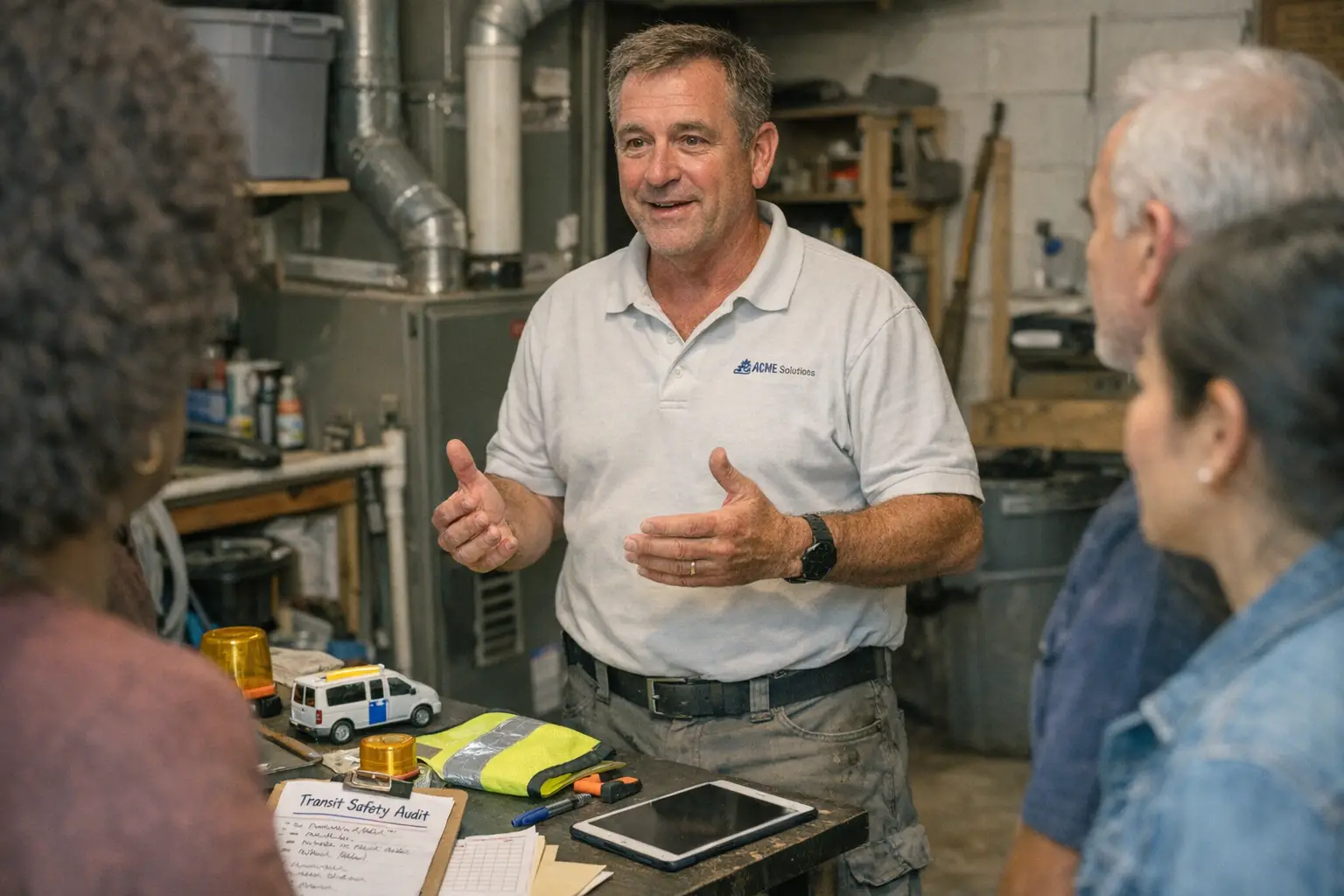
Start with one high-impact audit. Walk one trip end to end with disabled riders present, time every friction point, and fix the most dangerous break first.
Put these ideas to work
Most articles end exactly where the real work begins. If accessible transportation matters to your organization this year, Gray Group International can help you decide what to do first, what to leave alone, and how to tell within a quarter whether the bet is paying off. We bring the outside view and the hard questions; you keep the decisions, the plan, and the credit.
Discover more insights in Blog, our full collection of articles on this topic.
Join Disruptors Digest
Insights for a future worth creating. Sustainability, lifestyle, business, and beyond.
Gray Group International is a growth studio helping businesses attract, convert, and retain customers. Our consulting arm, gardenpatch, offers hands-on playbooks and strategy sessions.
